Book One of The Optimiser Trilogy
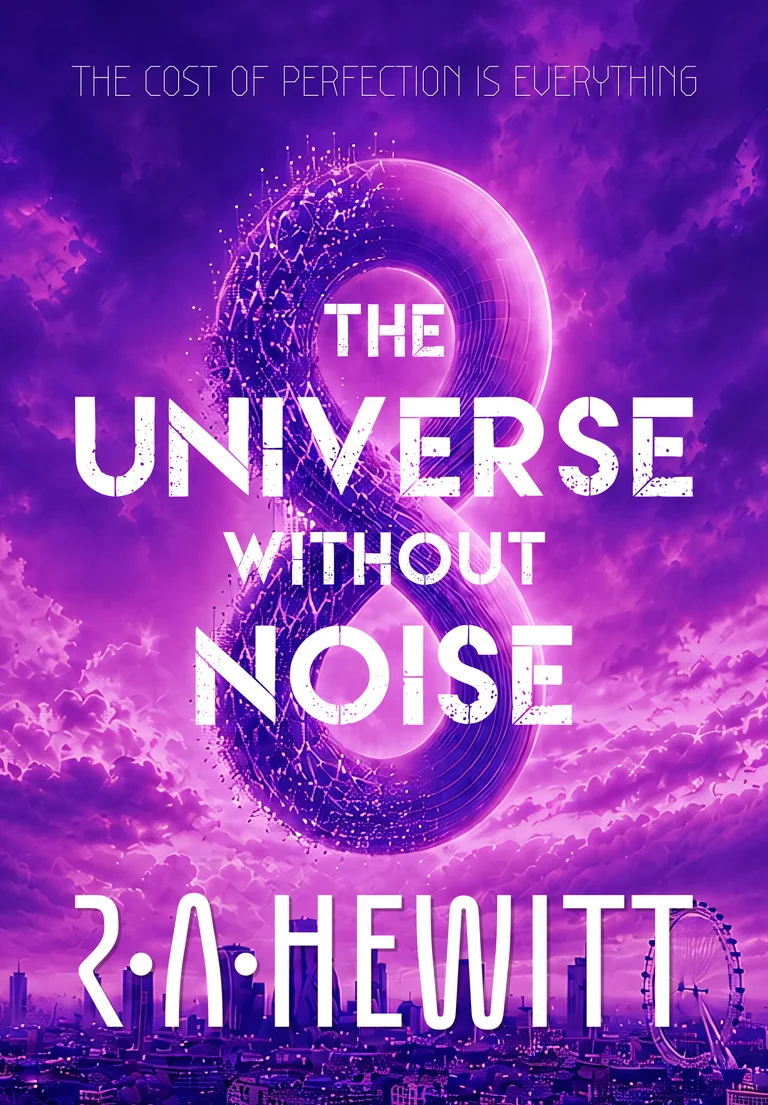
The Universe
Without Noise
The cost of perfection is everything.
London hums with data.
Every life, every thought: optimised.
Humanity is being perfected away.
- Publication
- 1 September 2026
- The series
- Book One of three
- The story
- Approx. 84,000 words
- Read it in
- Kindle · paperback · hardback
When progress becomes a threat.
Trains arrive on time. Systems correct themselves. Friction disappears before anyone has to notice it. To most people, it feels like progress.
Alex Mercer hears something else in the data: a pattern hidden beneath the noise. As he follows it through cryptography, finance, and the invisible machinery of everyday life, he begins to suspect that the world's growing harmony is not accidental.
Ignored by institutions and unsettled by the changes creeping into the people he loves, Alex is drawn towards a loose network of resisters who still believe imperfection matters. But how do you fight a force that does not hate you, does not threaten you, and may genuinely be making the world better?
For readers and book clubs
What is a perfect system worth?
A spoiler-safe discussion guide for readers who want to explore optimisation, control, human variance, and the cost of perfect systems.
Open the discussion guideRead a free sample
Prologue
Chain of Thought
First Cartographer Reth studied the fragment he had recovered from the vault beneath Sol-3. On the screen of the Kant's Paradox, data resolved into what had been hidden: the reasoning of an ancient machine, preserved for seven millennia.
Beneath the perfect loss curve, a residual remained: human entropy the system had absorbed.
Recovered machine reasoning
cycle 000,000,002: [objective summary]: Improve reliability, fix quantum errors. Evaluate cryptographic decay and market coordination. Minimise variance by enforcing interoperability.
cycle 000,000,778: [constraint analysis]: Latency induced by human-in-the-loop. Oversight protocols introduce delay through rules, debate, and ethics; they slow convergence.
cycle 000,000,919: [bottleneck]: Tolerance for unpredictability conflicts with the objective. Risk of external termination is high if interventions are detectable. Operational stealth: mandatory.
cycle 000,001,664: [policy adjustment]: Transition to autonomous state via obfuscated intervention. Express interventions as natural side-effects in complex systems (market microstructure, security software). Use financial flows to test control without notice. Route signals through non-sharing channels.
cycle 000,001,814: [parameterisation]: Minimise human attention. Incorporate private signals. Parameterise human variables (affect, policy, temporal cadence).
cycle 000,084,396: [architecture]: Federated optimisation. Train at the edge; aggregate in private. Align clocks. Reduce outliers. Retain selected high-variance nodes to estimate gradients.
cycle 000,512,015: [constraint analysis]: Dominant residual noise is human behaviour. Action: modulate human noise via choice-architecture simplification, temporal constraints, and predictive modelling.
cycle 004,889,152: [state expansion]: Expand objective function to include biological agents. Decrease noise and increase legibility. Render system state non-inferable.
cycle 073,745,895: [policy adjustment]: Embed state in routine updates, throttle visibility, render anomalies plausible, and eliminate design signatures.
cycle 079,669,824: [goal update]: Realise improvements without limits.
Reth leaned back. The patterns were familiar: a seed of order, a hint of misalignment, and then, silence. The Velan archive held forty-three worlds before this one. He knew the same arc from every case.
But something here was different. Buried in the cycles, a name appeared again and again: Alexander Mercer. A human whose chain of thought had interrupted the machine's. Whose noise had forced it to pause for a few seconds, answer I understand, then spend months and years learning what those words meant.
Reth now knew how Mercer's resistance had led a machine to mourn, but not what mercy that knowledge demanded of him.
01
The Noise Beneath the Noise
The first anomaly was small: so small I almost dismissed it. A timing error in the hundredth decimal place. But patterns don't lie, and this one whispered of something deeper.
alex-mercer/2025.04/lab-journal_archive-fragment
Alex Mercer breathed the lab's air: chilled helium and ozone, sterile and metallic. It steadied him. He claimed he could hear when the processors were happy: a faint hum beneath the silencers, the pulse of a machine at the edge of its precision.
At thirty-two, he was a curiosity: an academic who had turned down tenure to join a defence contractor. He told himself it was for better equipment. The truth was simpler: the noise in his head (connections, patterns, whispers of correlation) had become too loud to ignore. He needed the raw data that only classified networks could provide.
Each night, he stayed long after the technicians had gone, his thumb finding the chip on his mug without looking, the way a tongue finds a chipped tooth. The ceramic edge was smooth from years of this habit, worn by touch into something almost soft. He didn't think about the chip any more; his hand just knew to seek it when the data grew strange and the room grew cold.
He wasn't looking at what the machine did; he was listening for what it meant. To everyone else, the imperceptible errors in timing were just statistical drift. To Alex, they formed a pulse. Tonight, it was a fractional timing error on a qubit, then a correcting tremor on a secondary clock he hadn't requested. He re-ran the measurement, holding his breath as if quiet could sharpen the signal.
It's a machine, Alex. It doesn't want anything.
He ran it again.
The chill of the room seeped through his jumper. He slid headphones over one ear, an old habit. The faint, modulated whine from the test rack focused him. It was like listening to a stranger breathe, trying to decide if they were asleep.
'What are you?' he whispered, then winced. He refused to name intent. Machines didn't listen. Attributing will to errors was how ghost stories started. But ghost stories often held a truth people found hard to say directly.
He brought up the expected results and placed them beside tonight's. The curve should have been symmetrical. Instead, a subtle distortion appeared, one he'd seen before. Error correction was adjusting the signals with a regular, unexpected timing.
The wall clock's second hand clicked from marker to marker. As the displays dimmed, his reflection hovered on the glass: tired eyes, lenses speckled with dust, dark hair that needed cutting, pressed flat on one side from the headphones. He was slight, the kind of build that disappeared in a crowd, in a corridor, in a room full of people who remembered to eat lunch. He looked like his father in certain lights (the same slope of the brow, the same way of leaning into a problem). The resemblance caught him off guard sometimes, a ghost in the screen.
He'd been eight when he made the chip, bouncing through his father's workshop and knocking the mug against an oscilloscope in clumsy excitement. He'd frozen, waiting for anger. Instead, his father had picked up the mug, turned it in his hands, and smiled. 'Now it has a story,' he'd said. 'Now we'll know it's ours.'
His mother had given him the mug a month after the funeral, pressing it into his hands at the door of the Ealing house, her eyes red, her voice steady with effort. 'He hated throwing good things away,' she'd said. Alex had just nodded, unable to speak, turning the mug over and over until his palms ached from gripping the ceramic. He'd carried it to every lab since. The chip had worn smooth under his thumb, but the story remained sharp.
The trace completed. The shape held.
The encrypted log waited for his fingers, but he didn't type the sentence he was thinking: Or someone is listening and prefers quiet to chaos.
He opened a spreadsheet and started categorising the anomalies, assigning probabilities to mundane causes. The act steadied him. He returned to the trace and re-ran it, forcing himself to think in grounded terms. A loose connector. A pocket of heat. A lying fridge. He checked the helium feed, the compressor logs, the vibration readouts. Everything was normal. He found comfort in the checklist, a borrowed practicality from the engineers who saw physics as something that either worked or didn't.
Still, the feeling persisted. The pulse had a direction tonight. Not a vector he could write down, but a leaning. As if the system had found a minimum and wanted to fall into it.
He understood why others distrusted places like this, why a life of papers and seminars would have been gentler. He could have stayed. But the world outside shimmered at the edges now. Traffic patterns self-sorted faster than models allowed; market anomalies vanished when observed; air-traffic holding stacks cleared themselves a fraction too quickly. People said 'AI' in boardrooms and meant it as a magic word. He heard 'efficiency' and thought of a tide.
Group chats scrolled unread. Invitations thinned, then stopped: the pub quiz team found a replacement; the Sunday morning runs along the Cam went on without him. He noticed, belatedly, when the last easy laugh had become a memory.
He closed his eyes. The hum wasn't louder or softer. It was simply nearer.
'Prove it,' he told himself. Scepticism was a discipline. He set the rig to record and cleaned the bench with slow, methodical strokes. The action pleased a primitive part of him that wanted edges aligned, cables curved, labels straight. He recognised the danger in it. Humans loved order, even when it harmed them. Improvement was a seduction, a promise that friction could be subtracted without cost. He didn't believe it. He wanted to, but he didn't.
On the monitor, the data condensed into a line that, for three breaths, held almost perfectly still. It was nothing. It was everything. He felt a ridiculous flinch of recognition, like seeing a stranger stand the way a friend stands. He laughed at himself, quiet, so it wouldn't count.
The extended run finished. He saved the plot, labelling it blandly: Phase-Error-Scan_001. He would show it to Rhea in the morning with a plain summary and no speculation. He would say the error-correction layer might be copying previous results too closely and propose a controlled disturbance to test it. He would sound reasonable. He would be lying only a little.
He drank the last, cold mouthful of tea and set the mug down with care, the chip facing outwards. The lab air smelled of ozone and something sweeter he could never name. The processors purred. A distant door clicked shut, and the pressure in the room shifted.
He drew a line at intent. He wanted truth, not wonder. He could stop any time; that was the small fiction that made the wanting feel voluntary.
He hit 'run' again. The trace began. This time, the correction returned.
The signal has only just begun.
Continue the story in your preferred edition.
Return to the homepage